Thursday, August 27, 2009

"Fast Car" Poetry Annotation

Poetry Annotation - "Fast Car" by Tracy Chapman
This week we began the poetry annotation by working with "Fast Car" by Tracy Chapman.


Here's the assignment.

English 12 Unit 1:
”Fast Car” Model Annotation

Know:
The goal of this assignment is to learn how to annotate a poem. This will help you better understand the meaning and purpose of a poem.

Understand:
You will understand how finding the speaker (personae), audience(s), purpose and argument aids in your better understanding a piece of writing.

Do:
In small groups you will do an annotation of the poem and present it to the class.

What You Need:
o A Small Group to Work With
o 1 Extra Copy of Fast Car Lyrics (I've included them at the bottom of this posting)
o Scissors
o Tape or Glue
o Colored Markers or Pencils
o 1 Extra Large Sheet of Paper

English 12 Unit 1:
”Fast Car” Model Annotation

1. Cut up the poem so that it can
be attached to the poster in one
continuous column.

2. Write the names of your
group members on the front
of the poster.

Reread the poem and begin
To mark words, phrases and lines that help you figure out:
Speaker
o Who the speaker is and what you know about them.
o What is the speaker like?
o What has happened to the speaker?
o What is the speaker’s attitude towards the event(s),
o Etc.
Audience(s)
o Who is/are the intended audience?
o How do you know this?
Purpose:
o Why did this person take time to write the poem?
o What is the message?
o Are there multiple messages? If so, what are they? Who are they intended for?
Argument:
o What does the speaker want you to do with the information?
o How does the speaker want you to behave or change?

-----------------

You got a fast car
I want a ticket to anywhere
Maybe we make a deal
Maybe together we can get somewhere

Anyplace is better
Starting from zero got nothing to lose
Maybe we'll make something
But me myself I got nothing to prove

You got a fast car
And I got a plan to get us out of here
I been working at the convenience store
Managed to save just a little bit of money
We won't have to drive too far
Just 'cross the border and into the city
You and I can both get jobs
And finally see what it means to be living

You see my old man's got a problem
He live with the bottle that's the way it is
He says his body's too old for working
I say his body's too young to look like his
My mama went off and left him
She wanted more from life than he could give
I said somebody's got to take care of him
So I quit school and that's what I did

You got a fast car
But is it fast enough so we can fly away
We gotta make a decision
We leave tonight or live and die this way

I remember we were driving driving in your car
The speed so fast I felt like I was drunk
City lights lay out before us
And your arm felt nice wrapped 'round my shoulder
And I had a feeling that I belonged
And I had a feeling I could be someone, be someone, be someone

You got a fast car
And we go cruising to entertain ourselves
You still ain't got a job
And I work in a market as a checkout girl
I know things will get better
You'll find work and I'll get promoted
We'll move out of the shelter
Buy a big house and live in the suburbs
You got a fast car
And I got a job that pays all our bills
You stay out drinking late at the bar
See more of your friends than you do of your kids
I'd always hoped for better
Thought maybe together you and me would find it
I got no plans I ain't going nowhere
So take your fast car and keep on driving

You got a fast car
But is it fast enough so you can fly away
You gotta make a decision
You leave tonight or live and die this way

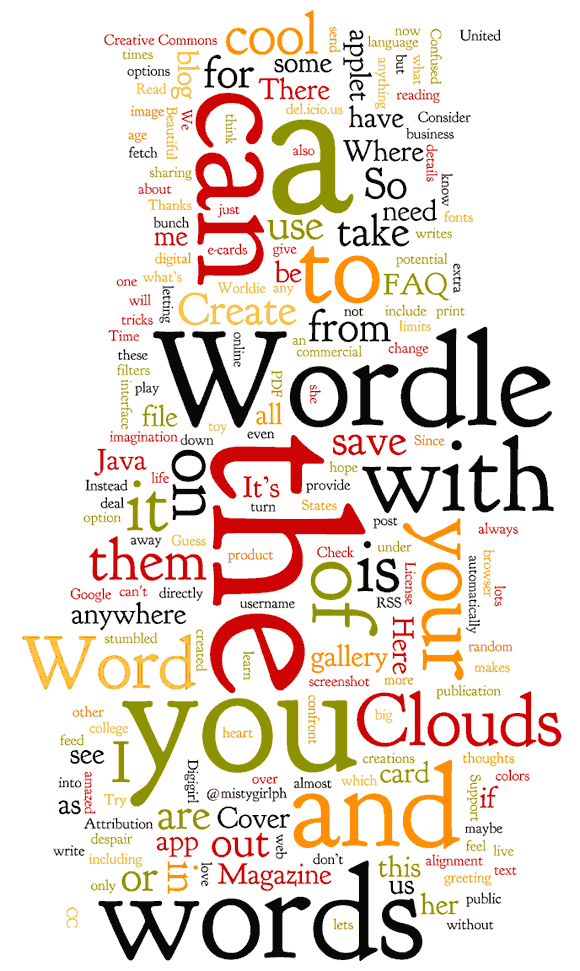
Creating a Wordle Word Cloud


Creating You Wordle
Part 1:
Ø Create a list of words, phrases, song and/or movie titles, events, objects, etc. that describe you in some way. You need to have at least 20 things on your list and they must be a variety of types of thing. For example, please do not simply list the titles of 20 songs. Perhaps you could have four titles of songs, four titles of movies, four phrases you find yourself saying often, 4 words your best friend would use to describe you, and so on.

Ø Underline the most important ones. Please try to underline at least four of them.

Ø Go to Wordle.net and create a word cloud from these words. Be sure your first name is the largest word in your word cloud. Print your wordle and use it with your personal poster. We will be printing in black and white. If you want to print it again, or in color be sure to save it in the gallery. That will allow you to get it again.

Wordle Tips:
If you want a word to be larger than the rest type it several times. For example, if you type your name four times it will be much larger than the other words. The words that are kind of important could be typed out two or three times to make them slightly bigger.

If you want to keep a set of words/phrases together be sure to place a ~ between the words. The program will read this as a linking space. The ~ will not show up on your word cloud.

Be sure to block and copy what you typed out in your text box before you hit, "GO" and see your wordle word cloud. If you don't like what you see you can go back, paste in the text again and add to it. If you do not do this you will have to retype everything as it does not save what you entered.

You can change up the colors by selecting Color>Edit Color Paletter> Click on the squares to pull up a color palette. Pick four colors and they will be inserted.

The default setting for Wordle does not include numbers. You can turn this feature on when you go to view your wordle word cloud. Click on "Language" and uncheck "Remove Numbers".

You can have a fun time by selecting Randomize from the bottom of the screen. The program will select new fonts and positions. Be aware that by doing this you cannot go back to a previous version of the word cloud.

If you decide to save something in the gallery be sure that you do not use your full name or publish anything that should not be available to anyone who accesses the Internet!

Have fun! Check Out the Gallery for interesting ideas!

We completed these on Wednesday, August 26th. It was due at the end of class. It is worth 50 points.

Thursday, August 20, 2009

Quotes on Identity

Here are the quotes we used in our preunit learning activity:

An identity would seem to be arrived at by the way in which the person faces and uses his experience.
James Baldwin

As a young teenager I looked desperately for things to read that might excuse me or assure me I wasn't the only one, that might confirm an identity I was unhappily piecing together.
Edmund White

First of all, what happens is, when you're good at something, you spend a lot of time with it. People identify you with that sport, so it becomes part of your identity.
Mike Krzyzewski

Human identity is the most fragile thing that we have, and it's often only found in moments of truth.
Alan Rudolph

I have done everything I can to make sure my daughter knows her father because you form your own identity by rebelling against your parents - but first you have to know them.
Greta Scacchi

Joy, rather than happiness, is the goal of life, for joy is the emotion which accompanies our fulfilling our natures as human beings. It is based on the experience of one's identity as a being of worth and dignity.
Rollo May

Strengthening our identity is one way or reinforcing people's confidence and sense of citizenship and well-being.
David Blunkett

The firmest friendship is based on an identity of likes and dislikes.
Sallust

We don't need a melting pot in this country, folks. We need a salad bowl. In a salad bowl, you put in the different things. You want the vegetables - the lettuce, the cucumbers, the onions, the green peppers - to maintain their identity. You appreciate differences.
Jane Elliot

Unlike a drop of water which loses its identity when it joins the ocean, man does not lose his being in the society in which he lives. Man's life is independent. He is born not for the development of the society alone, but for the development of his self.
B. R. Ambedkar

You have your identity
when you find out, not what you can keep your mind on, but what you can't keep your mind off.
A. R. Ammons

Your life will be a blessed and balanced experience if you first honor your identity and priority.
Russell M. Nelson

You manifest based on who you are already - so you must own the identity of the dream in order to manifest it.
Joy Page

First say to yourself what you would be; and then do what you have to do. ~Epictetus

You cannot belong to anyone else until you belong to yourself. -Pearl Bailey

Telling others about oneself is...no simple matter. It depends on what we think they think we ought to be like—or what selves in general ought to be like. Nor do our calculations end when we come to telling ourselves about ourselves. Our self-directed self-making narratives early come to express what we think others expect us to be like. Without much awareness of it, we develop a decorum for telling ourselves about ourselves: how to be frank with ourselves, how not to offend others....
-Jerome Bruner

It is better to conquer yourself than to win a thousand battles. Then the victory is yours. It cannot be taken from you, not by angels or by demons, heaven or hell.
-Buddha

A verse from the Veda says, 'What you see, you become.' In other words, just the experience of perceiving the world makes you what you are. This is a quite literal statement.
-Deepak Chopra

Always be a first rate version of yourself, and not a second rate version of someone else.
-Judy Garland

No man, for any considerable period, can wear one face to himself, and another to the multitude, without finally getting bewildered as to which may be the true.
-Nathaniel Hawthorne

If most of us remain ignorant of ourselves, it is because self-knowledge is painful and we prefer the pleasures of illusion.
-Aldous Huxley

"We are so accustomed to disguise ourselves to others that in the end we become disguised to ourselves."
-François de La Rochefoucauld

Beware of no man more than yourself; we carry our worst enemies within us.
-C. H. (Charles Haddon) Spurgeon

“Memory is a way of holding on to the things you love, the things you are, the things you never want to lose.” ~ Kevin Arnold

“If you wake up at a different time, in a different place, could you wake up as a different person?” ~ Chuck Palahniuk

The value of identity of course is that so often with it comes purpose.” ~Richard R. Grant

“Identity is such a crucial affair that one shouldn't rush into it.” ~ David Quammen

“Identity is theft of the self” ~ Estee Martin

“The identity of one changes with how one perceives reality” ~ Vithu Jeyaloganathan

~ I think history is inextricably linked to identity. If you don't know your history, if you don't know your family, who are you? ~ Mary Pipher

~ Integrity simple means not violating one's own identity. ~
Erich Fromm

A people must have dignity and identity. ~Andrew Goodman

A racial community provides not only a sense of identity, that luxury of looking into another's face and seeing yourself reflected back, but a sense of security and support.
Wentworth Miller

Thursday, August 13, 2009

Welcome to Your Senior Year!

Your Senior year is exciting. You'll find that it is like no other year in your school career. We'll be doing some more personal and rhetorical writing. You'll be doing some technical writing, you'll lead some whole class discussions. It'll be great.

To start off, I'd like to post my syllabus for you:
Welcome to my class. I truly hope you will enjoy what we do. I am working hard to make sure that we satisfy all our requirements in an interesting manner. This year long course has seven main units. We will cover the first four this semester:

Unit 1- Many Selves, Many Voices – using poetry and an interview to become aware of the variety of voices writers and speakers use, and how these voices reflect a cultural context and a sense of the speaker’s individuality.

Unit 2 – Looking Forward & Getting Ready for the Next Step - using non-fiction and technical documents to explore the next step you may take, whether it is going to college or starting a career. We will be writing college entrance essays, cover letters for business purposes and creating a resume.

Unit 3 – Stranger in the Village – using essays to understand how encounters with others expand our own potential for self-expression, and understanding the risks associated with being either a “stranger” or a part of the “village.”

Unit 4 – A Medley of Voices – using a novel by Zora Neale Hurston to understand the connections between language and character, and to analyze historical/social//cultural contexts in literary works.

Students in English 12 will be expected to:
Attend class and be an active participant.
Read and interpret from a wide variety of genres.
· Write—notes, poems, essays, research papers and stories, —in response to what is being read and discussed in class.

Students and parents should understand that English 12 is designed to challenge every student. However, the extent to which an individual student is challenged will be dependent on the effort that the student puts into the class.

It is our desire that you become engaged in the coursework and that it becomes the subject of conversation between you and your instructors, your classmates, and your family.

I want you to succeed in my class. Even if you don’t feel like you’re “good” at writing or reading, you can still get a good grade in my class. So, you say, how do I do that? Here’s the drill:


· COME TO CLASS EVERYDAY! Having an interesting mix of students makes the class more fun. I want to see your smiling face every school day.

Absences & Tardies: I will be enforcing the school attendance policies. If you have excessive tardies (this means a lot of tardies or you are VERY late to class) I may require you to make-up that time during the access portion of the schedule or I may require you to clean desks during part of your passing period.

· BE PREPARED! For my class you will need your brain, a well fed body, a good attitude, respect, and the following supplies:
· Pens: All assignments must be done in pen or typed/word processed.

· 1 Three Ring Binder with Paper

· 1 Two-Pocket folder, preferably one that is punched and can travel within your notebook.

· Your Planner: This should be used to record assignment, especially homework due dates. It also serves as your hall pass.

· Markers or Colored Pencils that have been sharpened: (Optional) We will be doing some fun things in class that you require a nice visual presentation. Be sure to put your name on your markers or colored pencils.

· Post-It Notes: ( Optional, but Useful) You will need the small ones that you can write on. (1 3/8 x 1/7/8 or 2 7/8 x 2 7/8)

· A Highlighter

A Jefferson County Pubic Library Card: You can gain access to all of the databases that the Jeffco Public Library has if you have a library card. I would like you to tell me your card number and the name on the card so that you can access the databases even if you don’t have the card with you. If you do not have one you can get one by going to any Jeffco Public Library or by applying online at www.jefferson.lib.co.us. If you apply online you will need to pick it up within three days from when you applied for it.

Grading Criteria:
All assignments are given points. Grades are awarded based on points earned.

90% = A 80% = B 70% = C 69% = F

In keeping with the English Department Policy, no “D” grades will be awarded.

Okay, enough said? Feeling overwhelmed already? Stop and breathe. I am strict, but also fair. It is important to me that you know what is going on and expected in my class. I hope to see your face beaming with pride in your own excellent work and feel good about how well you have prepared yourself. Need help with any of this stuff? See me. I am always here before school, during the access period or you can schedule time with me as well.

Thursday, April 30, 2009

The 5 R's of Creative NonFiction by Lee Gutkind Questions

During my research on Creative NonFiction I found that "The 5Rs of Creative NonFiction" is a major article in this genre. I was lucky enough to find an online version of it. Please read the article and answer the questions. The article can be found:
http://www.creativenonfiction.org/thejournal/articles/issue06/06editor.htm

The 5 R’s of Creative Non-Fiction By Lee Gutkind
Comprehension Questions

1. What is your response to paragraphs 1-4 and 6-8?

2. What does the author mean when he uses the term “fly-on-the-wall” or “ living room sofa” concept of immersion?

3. Use your own words to describe what the author means when he uses the term, “immersion journalism”.

4. Read paragraph #12 * (“The other phrase…) to get a sense of what he means when he uses the term, “creative non-fiction”. Make a bulleted list that explains what creative nonfiction is according to this description:

5. Explain what Gutkind means when he writes about “’immersion’ or ‘real life’ aspect of the writing experience.” R1 = Real life)

6. What is reportage and how does it relate to creative nonfiction?

7. The R2 is reflection. Whose reflection are we talking about? Why is it important?

8. The is R3 research important? Why or how is it used in creative nonfiction?

• How does is launch and anchor the creative process?

• Why research? What is the benefit?

9. The R4 is reading? What kind of reading should be done? Why?

10. Explain the two phases of R5, writing

• Phase #1:

• Phase #2:

11. Why are vignettes important in creative nonfiction?

12. Explain the importance of the following elements of a scene:
• Action –

• Dialogue –

• Intimate and specific details –

13. What does he mean when he says, “The frame represents a way of ordering or controlling a writer’s narrative”?

• How do flashback figure into framing and storytelling?

14. Explain who the following people are and how they are connected:
• Richie Becker –

• Dave and Winkle Funk –

• Pvt. Rebecca Treat –

• Dr. Bartley Griffith

Wednesday, April 29, 2009

Creative Non-Fiction Article Review and Analysis

Creative Non-Fiction Article Review and Analysis


Please use the questions below to assess the creative nonfiction reading of your choice. You can elect to read:
"Where Meat Comes From" by Stranger Than Fiction: True Stories by Chuck Palahniuk
This is an reading about amaetur wrestling and an attempting to get on the Olympic Wrestling team.


"Beyond the Black Box" from Stiff: The Curious Lives of Human Cadavers by Mary Roach
Mary Roach displays her excellent writing talents when she shadows a forensic investigator who inspects the human remains from airplane crashes in order to determine what really happened.


" Because My Father Always Said He Was the Only Indian Who Saw Jimi Hendrix Play ’The Star-Spangled Banner’ at Woodstock " The Absolutely True Diary of a Part-Time Indian by Sherman Alexie
Sherman Alexie weaves his tale of his childhood and his longing to be loved by his father. He used the music of Jimi Hendrix as a way to get in contact with him.

Directions: Please select one of the writings from above and answer the questions below.

Title: Author:

Type: (circle one or two that seem to fit )
personal essay (any subject) memoir (memories of a life)
literary journalism (using fictional elements to tell a news story)
narrative history (retelling an event in history)
travel journalism nature/science essay

Real life: What real life event is this essay about?

Create a summary of what the text is about.
(What is going on? What is the story this writer tells?)


Sense of place/setting: What does the setting look like?
Feel like? Where is it? When is it?

Point of view: Who is telling the story?
Why did the author choose him/her?

What can he/she see or know that others might not or don't know?


Voice: Choose three of the following adjectives to describe the narrative voice in your essay:
serious | casual/informal | instructive | sincere |sarcastic | cocky | reflective | young | old | indignant | optimistic | pessimistic | honest | _________________________________ your own adjective

Explain why you chose those adjectives using reasoning and specific examples from the text:

*

*

*

Character: Who is the dominant character or person in this essay?

What do you know about him/her? Appearance? Personality?

What is it that he/she wants/needs/cares about, etc.?


Language
What is the tone (emotional quality) of this essay?
Use an emotion word for your answer.

How effectively does the author use any of the following:

Dialogue

figurative language (metaphor, simile, personification, hyperbole, etc.)

imagery. Choose one of these and give an example and say something about how it helps you understand the story.

Purpose/Theme/Impression: What does this essay reveal about life? Is it about human relationships? Is it about right and wrong? Is it about what is important? Be specific.


Style/ Quality:
In terms of the author's style and the major theme(s), what do you think are particularly significant passages (generally, 20 to 50 words each)?

What specific qualities of the text warrant its characterization as a work of literary nonfiction?

What are the distinguishing characteristics of the work?

What sort of reader does the writer seem to be targeting--and what sort of reader might gain the most enjoyment out of the work?

What is your overall evaluation of the reading?

---------------------
This worksheet has been an adaptation of the works of:
© 2008, Dawn Hogue ▪ Permission granted for classroom use only. Reprinting without permission not permitted.
And http://www.nt.armstrong.edu/lnbooks.htm#1

Monday, April 20, 2009

Creating Your Own Review Podcast on Voicethread.com

Creating Your Podcast- –Planning Stage

Now it is time for you to create a review. You may work alone or with one other person. You have a wide range of types of review you can do:
• Review a group of songs from a band/artist;
• Review a genre of music/art/film (such as punk rock, pop rock…)
• A list and review of the top ____ songs/films of 2008;
• A list and review of the songs/films that represent your generation;
• A list and review of ten songs you should listen to before you die,
• A list and review of ten movies everyone should see;
• A review of the history of a band and how it has changed over the years;
• A review of a film maker/actor and how their films have changed throughout their career;
• A review and history of a certain type of automobile;
• A review and critique of the history of a sports team/star.

• And so on – you get the idea. If you have an idea that is not on the list, see me for approval before you begin.

How many songs/ movies/ artists/ performers/ models/ makes do I need in my review?
If you work by yourself you must have at least four items in your review.
If you work with a partner you must have at least eight items in your review.

Important Things to Consider When Choosing Your Topic:
• Is your topic broad enough that you will have enough items to review?
• Is your topic appropriate for school?
• Can you find enough visuals to go with your audio? (You will need at least one per item.)
• If you select a topic that might have images that are blocked at school, will you be able to find time and internet access outside of school to get the images you will need? (For example, if you want to do a history and review of Metallica you would have to get many of the images outside of school.)
• Do you know enough about your topic to be able to talk about and review/critique it?

What Needs to Be Present in Your Review:

Here’s where your work on the deconstruction of a review graphic comes into play. You did that assignment in order to raise your awareness of how a professional review is constructed. Refer back to the graphic and the outline you made. Use it as a guide, but also feel free to deviate from it.

 A title slide that introduces your topic and includes your name(s);
 At least 4 (working alone) or 8 (working in pairs) of images related to your topic;
 Audio, usually music;
 Your spoken commentary –
 Introduce yourself/yourselves;
 Personal story connections;
 Personal Response and/or connection to review item or time period;
 Personal analysis;
 Clear transitions;
 Criteria for selection and/or inclusion;
 Introduction to genre / style / musical movement/classification, etc…
 Elements of style comments
 Background on band / song/film/actor/model, etc.
 History of band / song/ film/actor/model, etc.
 Transitional comments to the next segment
 Excerpt of song/ film still/ image of item, etc…
 Concluding comments
 A works cited page that documents all of your sources for research, images, reference, etc.

Creating a Review- Planning & Scripting
To do this assignment you can either:
1. Choose to plan and write out your entire script. The advantage of this option is that you might feel less nervous about recording your voice since you already know what you are going to say. The down side is that it may take you a while.

2. Choose to create a basic plan of what you will say. The advantage of this one is that you do not feel tied to a script. However, it can result in a lower quality podcast since there will most likely be a lot of pauses, “Uhms,” “ya’knows,” and so on. You can fix this by recording in Audacity.com. This is a free audio recording site that you can use to clean up your sound.

How to do this:
Get several copies of the StoryBoard Planning template (you'll need to get this from me. I could not make it upload correctly here) and begin to fill them in. Feel free to make your own if you prefer to type instead of write, or you need more room than I have included on the form.

1. If you are working alone you should have at least six images. A title slide, four images related to your content and a works cited page. Feel free to have more.

2. If you are working with a partner you should have at least ten images. A title slide, eight images related to your content and a works cited page. More images is always good.

 Go to Voicethread.com and sign up for an account.
 Watch the short video on all of the things you can do on Voicethread.
 Watch a few samples by clicking on the “browse” button and selecting three or more that look interesting to you.
 Now you need to load your images into VoiceThread. Remember, if you need to access images outside of school you can save them directly to your VoiceThread and not have to worry about saving them somewhere else.

 You can create your title and works cited slides in PowerPoint and post them in your VoiceThread.

 Once you have the images loaded take time to practice a bit before actually trying to record.

 I suggest that you figure out your content then look for images. As you find the right images add them to your VoiceThread. Be sure to put the works cited information on the last slide!

 Practice with your script, and your partner, if you have one.

 Be sure to save your VoiceThread before you add the audio. That way if you screw up the audio you can start from that point, instead of starting over.

 Once your happy you can turn it in. I will have you upload it to the class blog. You will need to let me know when you are ready to do this part.