"ve worked hard at putting together a nice set of readings to help ground you in Creative Non-Fiction and the variety of what is found within. Now I'd like you to spend some time perusing some of the places online where you can find more Creative Non-Fiction stories.
I've provided you with links that will provide you with lots of stories to choose from. Have a look at them, pick a story, read it and respond to it. At the end of this post you will find that I have included a generic response form that I would like you to complete.
I look forward to seeing what wonderful stories you will find and why you picked them.
Susan Orlean's article archive
The Santa Fe Writer's Project Archives (I suggest you look at the literary awards program stories)
2009 SFWP Literary Awards Program Stories
2007 SFWP Literary Awards Program Stories
Next, print your story. (Please note: If the story you choose is short, please pick a second one to go with it and do the activity twice.)
Now, please do the following:
Read the story and -
* Highlight the parts the you find interesting;
* Annotate in the margins -
- What questions do you have (for the author, about the topic, etc.)
- Have a conversation with the writer
* Make connections between you and what you read. What does this make you think about? How might you have reacted? Have you ever had something similar happen to you? And so on...
* What is your reaction?
Finally, complete "Creative Non-Fiction Article Review and Analysis" (below)
---------------------------------------------------------------------------
The Worksheet
Title: Author:
Type: (circle one or two that seem to fit )
personal essay (any subject)
memoir (memories of a life)
literary journalism (using fictional elements to tell a news story)
narrative history (retelling an event in history)
travel journalism
nature/science essay
Reason for Choice: Why did you pick this essay?
Real life: What real life event is this essay about?
Create a summary of what the text is about. (What is going on? What is the story this writer tells?)
Sense of place/setting: What does the setting look like?
Feel like? Where is it? When is it?
Point of view: Who is telling the story?
Why did the author choose him/her?
What can he/she see or know that others might not or don't know?
Voice: Choose three of the following adjectives to describe the narrative voice in your essay
serious | casual/informal | instructive | sincere |sarcastic | cocky | reflective | young | old | indignant | optimistic | pessimistic | honest | _________________________________ your own adjective
Explain why you chose those adjectives using reasoning and quote specific examples from the text:
*
*
*
Character: Who is the dominant character or person in this essay?
What do you know about him/her? Appearance? Personality?
What is it that he/she wants/needs/cares about, etc.?
Language
What is the tone (emotional quality) of this essay? Use an emotion word for your answer.
How effectively does the author use any of the following:
Dialogue
figurative language (metaphor, simile, personification, hyperbole, etc.)
imagery. Choose one of these and give an example and say something about how it helps you understand the story.
Purpose/Theme/Impression: What does this essay reveal about life? Is it about human relationships? Is it about
right and wrong? Is it about what is important? Be specific.
Style/ Quality:
In terms of the author's style and the major theme(s), what do you think are particularly significant passages (generally, 20 to 50 words each)?
What specific qualities of the text warrant its characterization as a work of literary nonfiction?
What are the distinguishing characteristics of the work?
What sort of reader does the writer seem to be targeting--and what sort of reader might gain the most enjoyment out of the work?
What is your overall evaluation of the reading
Do you think I should consider the piece you read as one of our required readings? Explain your answer with specific and clear reasoning. (Please be sure to note if there are any mature theme, curse words, etc. in the piece.)
This worksheet has been an adaptation of the works of:
© 2008, Dawn Hogue ▪ Permission granted for classroom use only. Reprinting without permission not permitted.
-----------
Here are some that some people found interesting:
"The Unwedding" Elizabeth Chase
"Dogs in Guatamala" by Patricia King
"Where Luck Lies" by Mary Larkin
"Animal Action" by Susan Orlean
Wednesday, April 28, 2010

Monday, April 19, 2010
Considering "Beyond the Black Box", "American Male, Age 10" , "American Food" - A British Perspective
I was pretty happy when I found these two pieces. We start off with Susan Orlean's "American Male Age 10" in which she offers us a thought provoking description of a 10 year old boy who lives in New Jersey. We'll round it off with a British broadcast about food in America.
These both take a close and descriptive look at everyday things we encounter. Our discussion and work with these pieces will be around the kinds of things each of these write choose to focus on, why they might have picked those items, and not others. We'll look at what kind of response that triggers in you and how their choice of adjectives evokes a reaction in the reader/listener.
We began reading it together in class and had some great discussion about what thoughts it brought up for some of the people in class.
Here's the story:"American Male Age Ten" by Susan Orlean

Here's what I would like you to do with it:
1. Read the story all the way through.
2. Go back and look at the topics presented in each paragraph. Pick out 10 categories of things about Colin that are described in the story. Make a chart that lists these categories (items such as what he looks like, what he expects adult life will be like, what he loves, etc.) down the left hand side of the paper. Put a column next to that and fill in the information for Colin. Then add another column and fill in the information about yourself. Try to answer it as much as you can from you at ten year old perspective. It should look something like this:
Category/Topic................Colin, 10.....................You
What he looks like............4"8' 75 pounds,
..............................handsome dark,
..............................smiley eyes,
..............................always wears a baseball cap
3. Now, take a closer look at Ms. Orlean's writing style. Make a list of at least 8 things that you notice.
4. Look at the section where she begins to write a dialogue between Colin and herself. She intersperses dialogue with descriptive paragraphs. Why do you think she writes this way? What is your response to it? What do you think is her intended impact on the reader?
5. Think about a scenario of some ordinary event that you remember of some similar time period in your life. Write about it using a style similar to Mrs. Orlean's style.
6. Why do you think Ms. Orlean writes out a conversation about the things he likes? What kinds of things are there on that list? What would have been on your list?
7. Towards the end of the writing she goes into great detail describing Colin's thinking about money. What might be the purpose of this focus? Why do you think this was described in such detail, while other things were merely mentioned?
8. Do you think Colin is an average American male at age 10? If so, why? If not, why?
9. If Ms. Orlean had written about you, what kinds of details concerning your life do you think she would find interesting and write about?
10. What are the strengths of this story?
11. Do you recommend that I keep this story in my collection for next year's class? Why or why not? Please make your thinking clear to me so that I can take it into consideration next year - Thanks!
12. Turn this in, making sure to include your name and "American Male Age 10" at the top of the paper.
---------
I'd like to now turn your ear to an intersting broadcast put out by the BBC. It is a popular culture piece by Simon Schama.

Here's the link. You'll need about 11-12 minutes to listen to it.
Simon Schama on American Food from the BBC.(11 minutes, including the BBC ad at the beginning.)
Simon Schama on American FoodListen:Listen now (10 minutes)
Synopsis
Simon Schama reflects on the quality of American food and eating habits and welcomes what he sees as the growing popularity of ethnic dishes and local farm produce. Excellent fresh food and good cooking has always existed, he says, in hidden pockets of the countryside but now he sees it being bought and enjoyed by more city dwellers, too.
Here's our activity with this piece:
1. Before we begin listening to this podcast, I'd like you to write about how you see American food. Give a brief response to the following types of American food:
Airport food
Fast Food
Food from Small/Family Owned Restuarants
Ethnic Food (Mexican, Chinese, Russian, Hmong, Vietnamese, etc.)
2. Mr. Schama states that Americans are not "so much in search of food, as fuel." What do you think this means?
3. He goes on to describe Americans as focused on the "speed of eating [and so much] brutal chewing... Most American eating seemed swift and silent...befitted a bodily function" instead of the social occasion as it is for the British. What is your reaction to such a description?
4. Schama shifts from such unpleasantries to describe pies in mouthwatering detail many pies. Why do you think he waxes poetically about the pie and the people who eat it?
5. Mr. Schama goes back and forth between negative descriptions of "waterly Cesar Salad with cardboard croutons..." and "places where you'll find that Real McCoy". Do you think this kind of contrast is due to a personal bias on the part of Mr. Schama, or is it an accurate description of the foods or is it an unfair comparision between fast food and finer dinning? Could it be a combination of all of those factors? Write out your thougths on this contrast and transition.
6. About 7 minutes into the recording Mr. Schama describes his experience of getting some barbequed chicken from a local "hole in the wall" restuarant. He goes on to describe the experience and the reaction of others. Try your hand and describing some meal that you have enjoyed.
7. Next up is a description of ethnic food. You can tell by what he shares with us that he is not in Colorado, but back East. What do you think he would descripe if he were here? What kinds of ethnic food would he find here?
8. What do you think he means by "agribusiness"? (9.10+)
9. If Mr. Schama were to come and spend some time with you, asking you to show him American food in Colorado, where would you take him (assuming you did not have to worry about the cost of the adventure or the time to travel to the places you desired)? Pick at least five places you would take them? Explain why you picked each of the places and what each one represents.
10. What did you think about this podcast? Should I keep it for next year?
(If you liked this kind of podcast you can find a bigger variety of them by looking up "Society & Culture: Personal Journals" on Itunes.com. You might find "This College Life" to be interesting, too)
If you are accessing this from a computer at school you can listen to it using Windows Media Player. You find it on the "S:" drive in the Student Shared folder>teacher folder>Language Arts> Welshon PoV_ with Simon Schama 16th
---------------------------------------------------------------------------------

Next up is a unusual piece that is really quite interesting. It is "Beyond the Black Box" from Stiff: The Curious Life of the Human Cadaver by Mary Roach. I don't have an electronic entry for this piece. You'll have to come to class to read it.
We've looked at it from a reader's point of view. Now I want you to shift your perspective and look at it from a critical angle. Here's what I'd like you to do:
Put yourself in the teacher's shoes and develop a learning activity to go with this reading. Please create about 10-12 questions and/or activities that are designed to help the reader comprehend the text better. You'll need items that address:
* Comprehension of key points in the text;
* A consideration of the craft of writing;
* Items that are designed to help the reader clarify confusing or complex parts of the text.
These both take a close and descriptive look at everyday things we encounter. Our discussion and work with these pieces will be around the kinds of things each of these write choose to focus on, why they might have picked those items, and not others. We'll look at what kind of response that triggers in you and how their choice of adjectives evokes a reaction in the reader/listener.
We began reading it together in class and had some great discussion about what thoughts it brought up for some of the people in class.
Here's the story:"American Male Age Ten" by Susan Orlean

Here's what I would like you to do with it:
1. Read the story all the way through.
2. Go back and look at the topics presented in each paragraph. Pick out 10 categories of things about Colin that are described in the story. Make a chart that lists these categories (items such as what he looks like, what he expects adult life will be like, what he loves, etc.) down the left hand side of the paper. Put a column next to that and fill in the information for Colin. Then add another column and fill in the information about yourself. Try to answer it as much as you can from you at ten year old perspective. It should look something like this:
Category/Topic................Colin, 10.....................You
What he looks like............4"8' 75 pounds,
..............................handsome dark,
..............................smiley eyes,
..............................always wears a baseball cap
3. Now, take a closer look at Ms. Orlean's writing style. Make a list of at least 8 things that you notice.
4. Look at the section where she begins to write a dialogue between Colin and herself. She intersperses dialogue with descriptive paragraphs. Why do you think she writes this way? What is your response to it? What do you think is her intended impact on the reader?
5. Think about a scenario of some ordinary event that you remember of some similar time period in your life. Write about it using a style similar to Mrs. Orlean's style.
6. Why do you think Ms. Orlean writes out a conversation about the things he likes? What kinds of things are there on that list? What would have been on your list?
7. Towards the end of the writing she goes into great detail describing Colin's thinking about money. What might be the purpose of this focus? Why do you think this was described in such detail, while other things were merely mentioned?
8. Do you think Colin is an average American male at age 10? If so, why? If not, why?
9. If Ms. Orlean had written about you, what kinds of details concerning your life do you think she would find interesting and write about?
10. What are the strengths of this story?
11. Do you recommend that I keep this story in my collection for next year's class? Why or why not? Please make your thinking clear to me so that I can take it into consideration next year - Thanks!
12. Turn this in, making sure to include your name and "American Male Age 10" at the top of the paper.
---------
I'd like to now turn your ear to an intersting broadcast put out by the BBC. It is a popular culture piece by Simon Schama.

Here's the link. You'll need about 11-12 minutes to listen to it.
Simon Schama on American Food from the BBC.(11 minutes, including the BBC ad at the beginning.)
Simon Schama on American FoodListen:Listen now (10 minutes)
Synopsis
Simon Schama reflects on the quality of American food and eating habits and welcomes what he sees as the growing popularity of ethnic dishes and local farm produce. Excellent fresh food and good cooking has always existed, he says, in hidden pockets of the countryside but now he sees it being bought and enjoyed by more city dwellers, too.
Here's our activity with this piece:
1. Before we begin listening to this podcast, I'd like you to write about how you see American food. Give a brief response to the following types of American food:
Airport food
Fast Food
Food from Small/Family Owned Restuarants
Ethnic Food (Mexican, Chinese, Russian, Hmong, Vietnamese, etc.)
2. Mr. Schama states that Americans are not "so much in search of food, as fuel." What do you think this means?
3. He goes on to describe Americans as focused on the "speed of eating [and so much] brutal chewing... Most American eating seemed swift and silent...befitted a bodily function" instead of the social occasion as it is for the British. What is your reaction to such a description?
4. Schama shifts from such unpleasantries to describe pies in mouthwatering detail many pies. Why do you think he waxes poetically about the pie and the people who eat it?
5. Mr. Schama goes back and forth between negative descriptions of "waterly Cesar Salad with cardboard croutons..." and "places where you'll find that Real McCoy". Do you think this kind of contrast is due to a personal bias on the part of Mr. Schama, or is it an accurate description of the foods or is it an unfair comparision between fast food and finer dinning? Could it be a combination of all of those factors? Write out your thougths on this contrast and transition.
6. About 7 minutes into the recording Mr. Schama describes his experience of getting some barbequed chicken from a local "hole in the wall" restuarant. He goes on to describe the experience and the reaction of others. Try your hand and describing some meal that you have enjoyed.
7. Next up is a description of ethnic food. You can tell by what he shares with us that he is not in Colorado, but back East. What do you think he would descripe if he were here? What kinds of ethnic food would he find here?
8. What do you think he means by "agribusiness"? (9.10+)
9. If Mr. Schama were to come and spend some time with you, asking you to show him American food in Colorado, where would you take him (assuming you did not have to worry about the cost of the adventure or the time to travel to the places you desired)? Pick at least five places you would take them? Explain why you picked each of the places and what each one represents.
10. What did you think about this podcast? Should I keep it for next year?
(If you liked this kind of podcast you can find a bigger variety of them by looking up "Society & Culture: Personal Journals" on Itunes.com. You might find "This College Life" to be interesting, too)
If you are accessing this from a computer at school you can listen to it using Windows Media Player. You find it on the "S:" drive in the Student Shared folder>teacher folder>Language Arts> Welshon PoV_ with Simon Schama 16th
---------------------------------------------------------------------------------
Next up is a unusual piece that is really quite interesting. It is "Beyond the Black Box" from Stiff: The Curious Life of the Human Cadaver by Mary Roach. I don't have an electronic entry for this piece. You'll have to come to class to read it.
We've looked at it from a reader's point of view. Now I want you to shift your perspective and look at it from a critical angle. Here's what I'd like you to do:
Put yourself in the teacher's shoes and develop a learning activity to go with this reading. Please create about 10-12 questions and/or activities that are designed to help the reader comprehend the text better. You'll need items that address:
* Comprehension of key points in the text;
* A consideration of the craft of writing;
* Items that are designed to help the reader clarify confusing or complex parts of the text.
Monday, April 12, 2010
Creative NonFiction - Taking a Closer Look, Step 1
Today we began to delve into the readings I have picked out for this unit.
All students read, "Badlands: Portrait of a Competitive Eater" by John O'Connor.

a href="http://justataste.com/wp-content/uploads/2009/06/badlands.png">
Next, each student read either:
"The Suicide/Murder? of Joseph Kupchik" by James Renner

or
"The Truth about Cops and Dogs" (a shorter version of the story is here.
<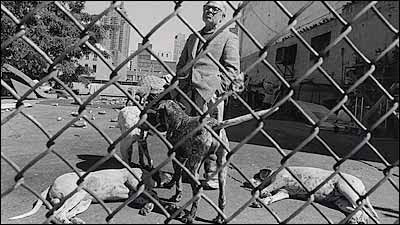 (photo by Eugene Richards)
We'll be thinking about the craft of the writing and what made these pieces stand out.
I'd also like to compare the "Badlands" essay to "Major League Eating: Eric "Badlands" Booker" by By Kelly Ann Senyei
We'll use the lenses of:
Personal Narrative (how are the writer's thoughts and personal response interwoven into the story? What impact does that have on how you read and respond to the text?)
Observation (what's noted and what's ignored - Why?)
Interpretation (how much room is there for you to make up your own mind? What is the writer's purpose, intent and intended audience?)
The Quality of the Craft of Writing
----
Here's the activity we did:
Creative Non-Fiction: A Close Look at the Craft of Writing
A Consideration of:
"Badlands: Portrait of a Competitive Eater" by John O'Connor.
"The Suicide/Murder? of Joseph Kupchik" by James Renner
"The Truth about Cops and Dogs"by Rebecca Skloot
---
Before we start:
Please write your name under the title of the story you read.
Get out 3 pieces of paper and something to write with.
Form a group of 3 -5 people who read the same story.
We will be discussing "Badlands" in small groups first, then sharing with the rest of the class. This will serve as a model of our process.
After we have gone through the model with a story we have all read, we will repeat a similar model with other groups.
---
We'll use the lenses of:
Personal Narrative
* How are the writer's thoughts and personal response interwoven into the story?
* What impact does that have on how you read and respond to the text?
Observation
* What's noted - Why?
* What's ignored - Why?
* As a reader,
Do you find anything missing?
Is there too much?
* As a writer,
What might you have done differently?
What would you have done the same?
Interpretation
* How much room is there for you to make up your own mind?
* What is the writer's purpose, intent and intended audience?
The Quality of the Craft of Writing
----
The following questions are in relation to "Badlands" with the group results being shared and posted
What caught your attention when you read the story? (Each group - please make a list of at least 10 things)
What did you notice about the writer's craft?
(Each group - please make a list of at least 10 things)
---
Personal Narrative
* How are the writer's thoughts and personal response interwoven into the story?
* What impact does that have on how you read and respond to the text?
---
* As a writer,
What might you have done differently?
What would you have done the same?
---
Interpretation
* How much room is there for you to make up your own mind?
* What is the writer's purpose, intent and intended audience?
----
----
Now we broke up into groups based on whether the student read "The Truth about Cops and Dogs" or "The Suicide/Murder of Joseph Kupchick and repeated the activity above.
The following questions are in relation to "Badlands"
What caught your attention when you read the story? (Each group - please make a list of at least 10 things)
What did you notice about the writer's craft?
(Each group - please make a list of at least 10 things)
---
Personal Narrative
* How are the writer's thoughts and personal response interwoven into the story?
* What impact does that have on how you read and respond to the text?
---
* As a writer,
What might you have done differently?
What would you have done the same?
---
Interpretation
* How much room is there for you to make up your own mind?
* What is the writer's purpose, intent and intended audience?
----
All students read, "Badlands: Portrait of a Competitive Eater" by John O'Connor.

a href="http://justataste.com/wp-content/uploads/2009/06/badlands.png">
Next, each student read either:
"The Suicide/Murder? of Joseph Kupchik" by James Renner

or
"The Truth about Cops and Dogs" (a shorter version of the story is here.
<
 (photo by Eugene Richards)
We'll be thinking about the craft of the writing and what made these pieces stand out.
I'd also like to compare the "Badlands" essay to "Major League Eating: Eric "Badlands" Booker" by By Kelly Ann Senyei
We'll use the lenses of:
Personal Narrative (how are the writer's thoughts and personal response interwoven into the story? What impact does that have on how you read and respond to the text?)
Observation (what's noted and what's ignored - Why?)
Interpretation (how much room is there for you to make up your own mind? What is the writer's purpose, intent and intended audience?)
The Quality of the Craft of Writing
----
Here's the activity we did:
Creative Non-Fiction: A Close Look at the Craft of Writing
A Consideration of:
"Badlands: Portrait of a Competitive Eater" by John O'Connor.
"The Suicide/Murder? of Joseph Kupchik" by James Renner
"The Truth about Cops and Dogs"by Rebecca Skloot
---
Before we start:
Please write your name under the title of the story you read.
Get out 3 pieces of paper and something to write with.
Form a group of 3 -5 people who read the same story.
We will be discussing "Badlands" in small groups first, then sharing with the rest of the class. This will serve as a model of our process.
After we have gone through the model with a story we have all read, we will repeat a similar model with other groups.
---
We'll use the lenses of:
Personal Narrative
* How are the writer's thoughts and personal response interwoven into the story?
* What impact does that have on how you read and respond to the text?
Observation
* What's noted - Why?
* What's ignored - Why?
* As a reader,
Do you find anything missing?
Is there too much?
* As a writer,
What might you have done differently?
What would you have done the same?
Interpretation
* How much room is there for you to make up your own mind?
* What is the writer's purpose, intent and intended audience?
The Quality of the Craft of Writing
----
The following questions are in relation to "Badlands" with the group results being shared and posted
What caught your attention when you read the story? (Each group - please make a list of at least 10 things)
What did you notice about the writer's craft?
(Each group - please make a list of at least 10 things)
---
Personal Narrative
* How are the writer's thoughts and personal response interwoven into the story?
* What impact does that have on how you read and respond to the text?
---
* As a writer,
What might you have done differently?
What would you have done the same?
---
Interpretation
* How much room is there for you to make up your own mind?
* What is the writer's purpose, intent and intended audience?
----
----
Now we broke up into groups based on whether the student read "The Truth about Cops and Dogs" or "The Suicide/Murder of Joseph Kupchick and repeated the activity above.
The following questions are in relation to "Badlands"
What caught your attention when you read the story? (Each group - please make a list of at least 10 things)
What did you notice about the writer's craft?
(Each group - please make a list of at least 10 things)
---
Personal Narrative
* How are the writer's thoughts and personal response interwoven into the story?
* What impact does that have on how you read and respond to the text?
---
* As a writer,
What might you have done differently?
What would you have done the same?
---
Interpretation
* How much room is there for you to make up your own mind?
* What is the writer's purpose, intent and intended audience?
----
Friday, March 26, 2010
The 5 R's of Creative Non-Fiction

Creative Non-Fiction is the newest genre in Literature. Last year this was the favorite unit of many of my seniors. Two of my seniors even went on to declare a Creative Non-Fiction major in college. I worked over the summer break last year to make it even better and am excited to share it with you.

First we begin with a cornerstone article about what it is. The 5 R’s of Creative Non-Fiction By Lee Gutkind is an interesting read. I've also put together some questions to help focus your reading.
As a side note: In the article Mr. Gutkind writes about a heart lung transplant. I believe that a longer set of essays on this topic comes from his book Many Sleepless Nights. I am trying to get a copy of that book to share some of those essays with you. If you want to read more of his outstanding writing, you can check out his website for a list of books, news and interesting information. You can also check out the Creative Non-Fiction Journal to find more great stories.

The 5 R’s of Creative Non-Fiction By Lee Gutkind
Comprehension Questions
1. What is your response to paragraphs 1-4 and 6-8?
2. What does the author mean when he uses the term “fly-on-the-wall” or “ living room sofa” concept of immersion?
3. Use your own words to describe what the author means when he uses the term, “immersion journalism”.
4. Read paragraph #12 * (“The other phrase…) to get a sense of what he means when he uses the term, “creative non-fiction”. Make a bulleted list that explains what creative nonfiction is according to this description:
5. Explain what Gutkind means when he writes about “’immersion’ or ‘real life’ aspect of the writing experience.” R1 = Real life)
6. What is reportage and how does it relate to creative nonfiction?
7. The R2 is reflection. Whose reflection are we talking about? Why is it important?
8. The is R3 research important? Why or how is it used in creative nonfiction?
• How does is launch and anchor the creative process?
• Why research? What is the benefit?
9. The R4 is reading? What kind of reading should be done? Why?
10. Explain the two phases of R5, writing
• Phase #1:
• Phase #2:
11. Why are vignettes important in creative nonfiction?
12. Explain the importance of the following elements of a scene:
• Action –
• Dialogue –
• Intimate and specific details –
13. What does he mean when he says, “The frame represents a way of ordering or controlling a writer’s narrative”?
• How do flashback figure into framing and storytelling?
14. Explain who the following people are and how they are connected: (Do this one carefully, many people get this question wrong.)
• Richie Becker –
• Dave and Winkle Funk –
• Pvt. Rebecca Treat –
• Dr. Bartley Griffith
Thursday, March 18, 2010
Creating Your Own Review Podcast
Creating Your Podcast- –Planning Stage
Now it is time for you to create a review. You may work in pairs or in a triad, though I think 3 people will make the assignment more difficult to complete. The other person/people working with you must have experience with the items that you are doing the review on:
• Review a group of songs from a band/artist;
• Review a genre of music/art/film (such as punk rock, pop rock…)
• A list and review of the top ____ songs/films of 2009;
• A list and review of the songs/films that represent your generation;
• A list and review of ten songs you should listen to before you die,
• A list and review of ten movies everyone should see;
• A review of the history of a band and how it has changed over the years;
• A review of a film maker/actor and how their films have changed throughout their career;
• A review of the best food to have at a party;
• A review of local restuarants.
• And so on – you get the idea. If you have an idea that is not on the list, see me for approval before you begin.
How many songs/ movies/ artists/ performers/ models/ makes do I need in my review?
You need to have three items per person in your group. Pairs will have six items and triads will have 9 items.
Important Things to Consider When Choosing Your Topic:
• Is your topic broad enough that you will have enough items to review?
• Is your topic appropriate for school?
• Can you find enough visuals to go with your audio? (You will need at least one per item.)
• If you select a topic that might have images that are blocked at school, will you be able to find time and internet access outside of school to get the images you will need? (For example, if you want to do a history and review of Metallica you would have to get many of the images outside of school.)
• Do you know enough about your topic to be able to talk about and review/critique it?
What Needs to Be Present in Your Review:
Here’s where your work on the deconstruction of a review graphic comes into play. You did that assignment in order to raise your awareness of how a professional review is constructed. Refer back to the graphic and the outline you made. Use it as a guide, but also feel free to deviate from it.
A title slide that introduces your topic and includes your name(s);
At least one image per item;
Audio, usually music;
Your spoken commentary –
Introduce yourself/yourselves;
Personal story connections;
Personal Response and/or connection to review item or time period;
Personal analysis;
Clear transitions;
Criteria for selection and/or inclusion;
Introduction to genre / style / musical movement/classification, etc…
Elements of style comments
Background on band / song/film/actor/model, etc.
History of band / song/ film/actor/model, etc.
Transitional comments to the next segment
Excerpt of song/ film still/ image of item, etc…
Concluding comments
A works cited page that documents all of your sources for research, images, reference, etc.
And so on - let me know if you need more information.
Creating a Review- Planning & Scripting
To do this assignment you can either:
1. Choose to plan and write out your entire script. The advantage of this option is that you might feel less nervous about recording your voice since you already know what you are going to say. The down side is that it may take you a while.
2. Choose to create a basic plan of what you will say. The advantage of this one is that you do not feel tied to a script. However, it can result in a lower quality podcast since there will most likely be a lot of pauses, “Uhms,” “ya’knows,” and so on. You can fix this by recording in Audacity.com. This is a free audio recording site that you can use to clean up your sound.
How to do this:
I suggest that you figure out your content then look for images. As you find the right images add them to your VoiceThread. Be sure to put the works cited information on the last slide!
You can create your show in PowerPoint and upload it, or create it directly in VoiceThread.com
Practice with your script, and your partner, if you have one.
Be sure to save your VoiceThread before you add the audio. That way if you screw up the audio you can start from that point, instead of starting over.
Be sure to put "welshonreview" in the tag line so that I can find it.
Title it something like yourfirstnamelastinitialreview (all lower case, all one word. Mine would be tammywreview).
Be sure to check the "Browse" button in the publishing options box.
Once your happy you can turn it in.
Tuesday, March 16, 2010
Deconstructing Music Reviews
Deconstructing Music Reviews
The goal with this assignment is for you to become very aware of what elements are present in a quality music review. Later you will have an opportunity to create a music review of your own based on what you find.
Process Overview:
1. You will select a music review that features at least two commentators from the NPR All Songs Considered Podcast Archives. I suggest either "Break Up Songs" or "Holiday Music";2. You will listen to at least 30 minutes of music review(s).
3. You will create a graphic flowchart that reveals the components of that/those review(s)
4. You will view the flowcharts others create
5. You may create your own music review in a multimedia format.
Step One – Listen to a Music Review Podcast
There are a number of wonderful music review podcasts offered by National Public Radio (NPR). You can download and listen to these from either the NPR.org website or the Itunes website. I also uploaded a few into the student shared folder. Go to either site and select a few podcasts to listen to.
Listening to them on NPR.org.
1. Go to npr.org.
2. From the program list select “All Songs Considered.”3. From this site you can select one of the programs offered by scrolling down the webpage. You can see more by selecting “Past Stories by Date.”
4. Select a podcast by clicking on the title. That will bring up a new screen. Click on Listen Now. This will bring up another box where you can listen to the podcast.
5. I would like you to listen to at least two podcasts for at least 15 minutes each or 30 minutes of one podcast. Remeber that you need a podcast that has two or more commentators.
(Break Up Song Podcast Direct Link Here)
OR You Can…
Listen to them on Itunes:
1. This will bring up another box where you can listen to the podcast.
2. I would like you to listen to at least two podcasts for at least 15 minutes each (for a total of 30 minutes minimum of listening to the podcasts)or 30 minutes of one podcast. Remeber that you need a podcast that has two or more commentators.
Step Two- Deconstruct a Review and Make a Graphic of the Elements of a Review
Go to Microsoft Word and make sure your drawing tools are available. If you do not see them on the bottom of your screen you may need to load them. You do this by selecting “View” from the tool bar at the top. Then select “toolbar” from the drop down menu. From there check “drawing.” This will make them available. From here you can get the shapes you need by clicking on “autoshapes” at the bottom of the screen. This will give you a flyout menu. You will pick “basic shapes” and then the shape you need.
Once you have figured out how to use the program, you will listen to very small bits of the podcast(s) and make a graphic that represents what kinds of things you are hearing. There are four general types of things you will hear in a podcast review:
Speaker’s personal comments;
Comments about the genre and/or elements of style;
Comments dealing specifically with the band/band members/band history/music;
Transitions between songs/albums/topics.
Make a graphic representation of the elements of the musical review.
Code the elements by using consistent shapes and shades of colors.
Personal Comments are done in squares and rectangles: (done in shades of green)Personal story connection
* Speaker introduction
* Personal Response and/or connection to self or time period
* Personal analysis
Musical / Genre Comments are in rounded rectangles and squares in shades of yellow:Criteria for selection and/or inclusion
* Introduction to genre / style / musical movement
* Elements of style comments
Music Related Comments are in circles
And ovals with shades of pink:* Background on band / song
* History of band / song
* Transitional comments to song
* Excerpt of song
Here’s what needs to be on your “Deconstructing a Review Podcast” document:
Your name
The title of the assignment
The title(s) of the podcast(s) you listened to and made a graphic of.
Be sure to use the shapes and colors as dictated in the assignment sheet.
Instead of generic comments in the shapes, write a very brief indication of what the speaker said or what audio was used. This includes things like song titles, band member names, summary of comments, etc.
Take particular note of how the speaker indicates that what they are saying is their personal opinion.
Take special note of how the speaker transitions from one segment of the review to another.
A print out of the graphic. (You will need to create the graphic in such a way that it will print out on one sheet of paper and still be legible. That is why I began wrapping around my boxes in the screen shoot above.)
I made my sample in Webspiration, a program that is no longer available. You can make a document that looks the same in Microsoft Word using the auotshapes available with the drawing tool.
Tips for Creating Your Graphic of the Review Podcast:
• Listen to the podcast that you are graphic at least one time without interrupting it.
• Open Microsoft Word. Make sure your drawing tools are available and get started.
• Open a second browser and listen to a very small bit of the podcast.
• Go to the Word screen and make the first few boxes. You will see a crosshair symbol on the screen.
• To create a box simply select a shape from the autoshape menu on the bottom of the screen. This will produce a shape. Resize it by dragging from the handles on the corners of the shape.
• Color the fill color by clicking on the symbol that looks like a bucket with a colored line below it. This is located on the bottom of your tool bar. Clicking on this will pull up a color menu. Select an appropriate color. It will be filled in with the same color that your shape is filled in with. Click on this to bring up a color palette. Select the color you like and check to see that your shape fill color is the same. You can get more choices by selecting “More Fill Choices” from that menu.
• To pick the font/type color look for the shape in the bottom toolbar that looks like rainbow in a box. Clicking on this will produce a set of colors to choose from.
• You will need to use the arrows that shows the flow of the comments. You can produce these by clicking on the diamond shapes found at the center points of the shapes. Clicking on the diamond shape and dragging will bring out the arrow.
• To print it go to document and select page set up. Next, select fit to page and okay. Then select print from the document menu.
Monday, March 8, 2010
The Writer's Craft Genre Study - Reviews & Critiques
We've started a genre study where we look at lots of reviews and critiques as a lens to view the craft of doing persuasive writing.
Part 1 - Deconstructing Reviews- Looking at Word Choice and Elements* We completed the following exercise two times. First, we read through "Whip It" from Spin Magazine. Next, the students had a variety of reviews to pick from and complete the chart on their own. The reviews and critiques were for albums and video games.
Persuasive Writing: Deconstructing Product
One of the main goals of this assignment is to make you metacognitively aware of the elements of product reviews so that you will be armed with the knowledge to decipher fact from opinion and bias. You will be using this knowledge to create your own review of a product.
(We completed the following chart. The one I used in class has boxes that don't translate to this blog.)
------------------------------------------------------------------------------------
Feature Detail Example from Review Analysis/ Commentary
------------------------------------------------------------------------------------
* Attention
Getter
* Introduction
of Speaker/Narrator/
Writer
* Background
Information
* Speaker’s
Personal
Commentary/
Opinion
* Comments
Dealing with the
Genre/
Elements of Style/
Product Specifics
* Comments
Dealing with the
Genre/
Elements of Style/
Product Specifics
* Comments/
Critique
About the item specifically
(as opposed to generalized comments)
* Conclusion/
Wrap-Up
* Notes on Style:
* Intended Audience:
------------------------------------------------------------------------------------
Next, we tried to see what kind of patterns emerged from this genre of writing. The students had eight mentor reviews and critiques to pick from and do the following:
Deconstructing Reviews: Finding the Form
The goal with this assignment is for you to become very aware of what elements are present in a review. Later you will have an opportunity to create a review of your own based on what you find.
Process Overview:
1. You will select a review;
2. You will read through the review once just to read it and see what is says.
3. Next, you will reread the review so that you can notice the writer’s craft and the form that the review takes.
4. You will create a graphic flowchart that reveals the components of that review.
5. You will view the flowcharts others create.
6. You’ll write your own review on a product of your choice.
There are four general types of things you will find in a review:
* Speaker’s personal comments;
* Comments about the genre and/or elements of style;
* Comments dealing specifically with the product, including specific details/stat.s/facts, etc.;
* Transitions between concepts.
Make a graphic representation of the elements of the review.
Code the elements by using consistent shapes and shades of colors. Within each shape you should quote the text so that the wording can be shared and considered when we look at the emerging patterns.
Personal Comments are done in squares and rectangles: (done in shades of green)
Personal story connection
Speaker introduction
Personal Response and/or connection to self or time period
Personal analysis
Category / Genre comments are in rounded rectangles and squares in shades of yellow:
Criteria for selection and/or inclusion
Introduction to genre / style / classification
Elements of style comments
Product Related Comments are in circles
And ovals with shades of pink:
Background
History of
Stat.s & Facts
Transitional between concepts
___________________________________________________________________________________
Part 2: Distilling What We Have Noticed
Having read and examined at least six reviews, we are now armed with some knowledge of what is included in a review or critique. In order to make that information useful we need to organize it.
We began by making a list of all of the qualities that a reader notices when reading a review or critique. From there we did an "Always, Sometimes, Never" chart of those elements. Each pair of students had to contribute at least three items to the lists which were then put in their respective categories. Each class then created a rubric of the most essential elements. These rubrics will help guide the student's writing and be used to grade their written reviews/critiques.
Here are the results:
Period 5:
Ideas and Content =
* Must have tested/expereinced the product
- Write about the time you used it
* Include details about it
Structure =
* Include Title
* Must have paragraphs
Style =
* Personal Opinion
* Include the positive and the negative
- Persasion/ Bias
Conventions =
* Use Simple and complex sentences
* Remeber to use commas
Period 6:
Ideas and Content=
* Opinion
- Include positive and negative
- Must have personal experience with the topic
- Bias
* Description
- Include facts
- Use very specific details
- Include some background information
Structure =
- Use Paragraphs
Introduction
Body
Conclusion
- Transitions
Style =
* Highlight specifics
* Use a rating system
Conventions =
* Use a combination of simple and complex sentences
* Be thoughtful about punctuation, especially comma use.
-------------------------------------------------------------------------------------
Part 3: Writing Your Own Review
Now that the students have each read at least six reviews and/or critiques, it is time to give it a try and write their own. I suggested that the students pick some product, place or activity that they have a strong (positive or negative) response to. The end product should look like a review/critique out of a magazine.
Subscribe to:
Posts (Atom)